

Headlines bring perspective… Actions capture opportunity
Doug Drabik discusses fixed income market conditions and offers insight for bond investors.
There are several non-political reasons the US/Iran conflict is an apropos topic for a bond market commentary. Last week, we emphasized the “storm” at hand. Preparing for a market downturn needs to occur during a thriving market, or you potentially miss the opportunity. Worse, delayed action to balance a long-term strategy could be acted upon at an inopportune time. This week, a colleague reminded me that it is human nature to be drawn to negative or controversial news and that we stare at media outlets and talk at the cooler, saturating ourselves with negativity. However, adverse events such as the Dot-com bubble or the 2008 Financial Crisis may also help keep things in perspective and perhaps serve as guardrails toward our ultimate positive investment goals.
Unfortunately, there is turmoil, evil, and uncertainty in the world. Geopolitical events can surface in a blink, and, like any unexpected incident, they can leave a trail of potential short- and long-term consequences. This last week was wrought with negative news. The Middle East conflict escalated with increased bombing, drones, and other intense warfare. Production and shipping of oil are compromised. Crude Oil Futures went from $67/barrel to $91/barrel, or a 35% increase in just a week.
The value of the stock markets dropped this week, but more notable is that stocks are down year-to-date. Adding to the negative news, payroll data was downbeat. The Change in Nonfarm Payrolls was expected to fall from the prior +130,000 to +55,000, but instead fell by -92,000.
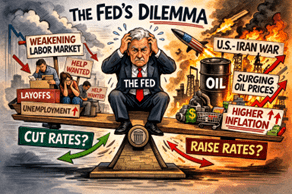
So here we are once again. The Fed is challenged with sorting out conflicting realities. The Fed is charged with keeping prices stable. The US/Iran conflict is impeding the efficiency of the oil market and driving up prices. Is this a temporary event or does it have a lasting impact? If core inflation numbers begin to rise, it is not inconceivable to think the Fed could raise the Fed Funds rate. On the other hand, the Fed is also tasked with keeping employment full. As payroll numbers turn negative and the unemployment rate rises, it is just as plausible for the Fed to consider cutting the Fed Funds rate.
My water cooler colleague further reminded me of a happy place. Although negative news grabs the headlines, investment portfolio success thrives on positive opportunities - not the wishful or prognosticated good, but the real opportunities in hand. The economic environment has supported higher interest rates for the past three years. Rates continue to offer plenty of income opportunities, while individual bonds also help preserve wealth. Investors have benefited in multiple ways over this period, and despite the negative news, there remains time to reduce market risk and transition accumulated wealth into cash flow and income opportunities through individual bonds.
The author of this material is a Trader in the Fixed Income Department of Raymond James & Associates (RJA), and is not an Analyst. Any opinions expressed may differ from opinions expressed by other departments of RJA, including our Equity Research Department, and are subject to change without notice. The data and information contained herein was obtained from sources considered to be reliable, but RJA does not guarantee its accuracy and/or completeness. Neither the information nor any opinions expressed constitute a solicitation for the purchase or sale of any security referred to herein. This material may include analysis of sectors, securities and/or derivatives that RJA may have positions, long or short, held proprietarily. RJA or its affiliates may execute transactions which may not be consistent with the report’s conclusions. RJA may also have performed investment banking services for the issuers of such securities. Investors should discuss the risks inherent in bonds with their Raymond James Financial Advisor. Risks include, but are not limited to, changes in interest rates, liquidity, credit quality, volatility, and duration. Past performance is no assurance of future results.
Investment products are: not deposits, not FDIC/NCUA insured, not insured by any government agency, not bank guaranteed, subject to risk and may lose value.
To learn more about the risks and rewards of investing in fixed income, access the Financial Industry Regulatory Authority’s website at finra.org/investors/learn-to-invest/types-investments/bonds and the Municipal Securities Rulemaking Board’s (MSRB) Electronic Municipal Market Access System (EMMA) at emma.msrb.org.